
Where a Range Hood Has to Vent, and Gas vs Electric vs Induction
What the Alberta code actually says about kitchen exhaust, how far a duct can run, the makeup air rule everybody quotes wrongly, and what changes behind the wall between gas, electric and induction.
By David Hutten, Owner, Green Ladder Contractors
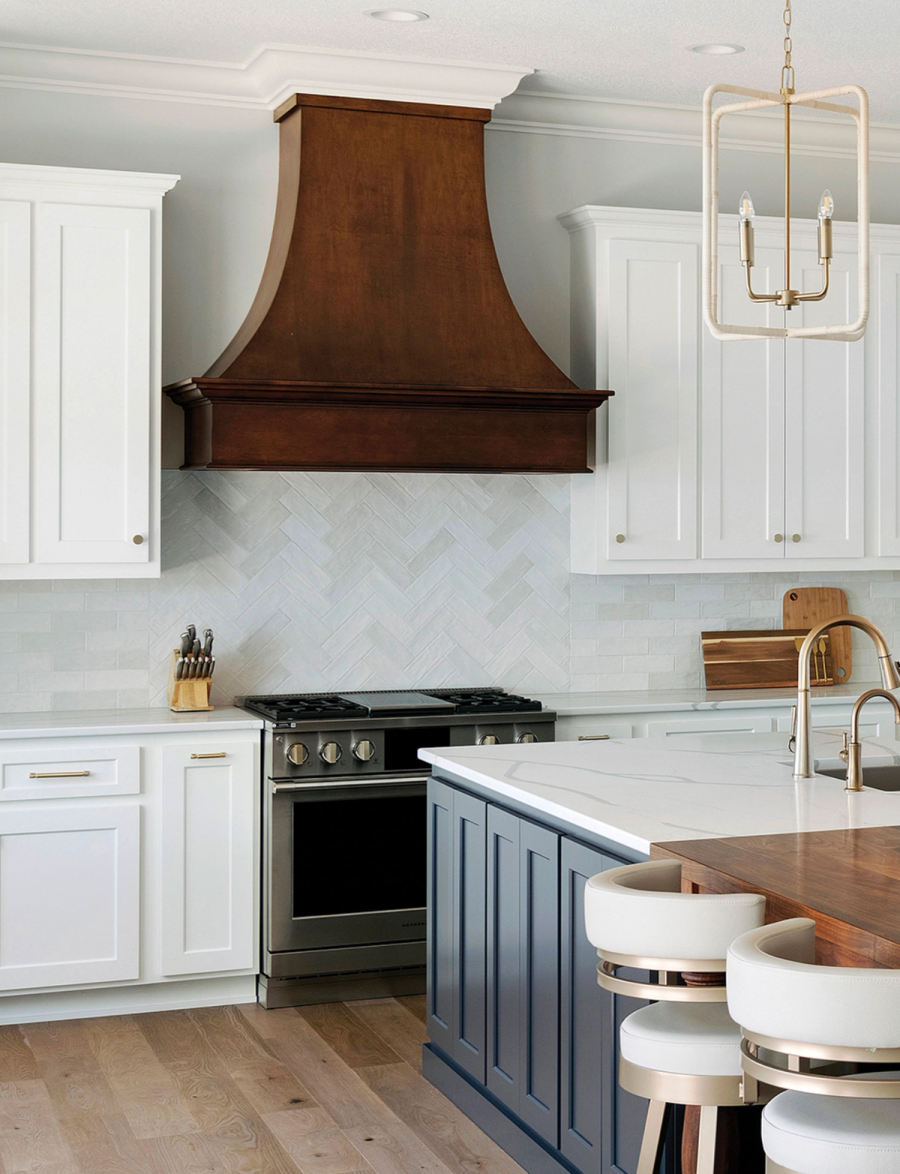
The range is the one appliance that decides where it can go, and the hood above it does the deciding. Everything else in a kitchen can be moved with enough plumbing and enough patience. A hood has to get its duct out of the building, and that single requirement quietly settles a lot of layouts before anybody has chosen a door style.
Here is what the Alberta code says about it, what it does not say, and how gas, electric and induction change the picture.
Every Alberta kitchen needs a fan
The National Building Code 2023 Alberta Edition, in force here since May 2024, asks for a supplemental exhaust fan of at least 50 L/s in each kitchen. That is about 106 CFM, and it is a floor rather than a target. A 30" range against a wall works better at 2 or 3 times that.
Where the duct is allowed to end
The code is short and blunt on this. Exhaust ducts do not discharge into heated or unheated enclosed spaces. That one sentence rules out the attic, the soffit, the crawl space and the garage, and it is the reason we keep saying a range needs an outside wall or a chase behind it.
Cooking exhaust duct also has to be noncombustible and corrosion resistant, lead directly outdoors with no connection to any other exhaust fan or duct, and carry a grease filter at the intake.
Two things people assume are in the code and are not. Nothing in the Alberta code says the duct has to be smooth, and nothing says it has to be rigid. Aluminum flex is noncombustible and corrosion resistant. It is the hood manufacturer, not the inspector, who tells you flex voids the warranty (the American code does say smooth - a lot of what a homeowner reads online is written to that one).
How far the duct can run
This is the table almost nobody quotes, and it catches an island hood on the far side of a house. Table 9.32.3.11.-A caps duct length by diameter, airflow and the static pressure the fan is rated at.
At 25 Pa, a 150 mm duct (about 6") moving 100 L/s (about 212 CFM) is good for 1 m. At 50 Pa the same duct gets 3 m. Step up to 200 mm (about 8") and that same airflow gets 5 m and 13 m.
So the fix for a long run is a bigger pipe, and the arithmetic is unforgiving on 6". And where flexible duct is used, the code allows it to be sized by picking the diameter for a duct twice as long as the real one. A 2:1 penalty for flex, written into the Alberta code, is a stronger argument than anything a tradesman can tell you.
One more matters in a Red Deer winter. Where a duct passes through an unheated space, or is not separated from one by an insulated assembly, it gets insulated to at least RSI 0.5. Warm wet air in a cold pipe condenses, and the water runs back down the duct to the hood.
How much fan, in numbers
The building code sets the floor and stops. For sizing above it, the Home Ventilating Institute publishes the figures the trade works from: 100 CFM for each linear foot of cooking surface against a wall, and 150 CFM per linear foot for a range in an island. Their minimums are 40 and 50. For a 30" range against a wall that is 250 CFM recommended and 100 CFM minimum.
Those are recommendations from an industry body and not code, and they are honest about their limits: for professional style cooktops they point you at the cooktop manufacturer instead.
Makeup air, and the number everybody quotes wrongly
Pull 600 CFM out of a tight house and something has to replace it. Where the house has a fuel burning appliance drawing its combustion air from inside, the replacement air can come down that appliance's own flue and bring the exhaust with it.
Almost every article on this says the threshold is 400 CFM. That figure is from the American code and it does not apply in Alberta. The Alberta trigger is not a CFM number at all. It is the appliance. Article 9.32.3.8 applies to any dwelling containing a fuel fired space heating or water heating appliance of other than direct vented or mechanically vented type. Where it applies, any exhaust device gets matched makeup air from a fan rated at not less than the exhaust capacity and not more than that capacity plus 10%, wired to run whenever the exhaust runs.
The catch in an older Red Deer house is the water heater. A high efficiency furnace vents out the side wall and takes itself out of scope, but a conventional tank water heater with a draft hood does not, and that one appliance brings the whole house inside the article. So a hood upgrade in a 1970s bungalow can land in a very different place than the same hood in a 2015 build.
Where that makeup air goes is its own problem in January. The code gives 2 ways to do it: introduce it to a normally unoccupied area, or temper it to at least 12°C before it reaches occupied rooms or a supply duct. Heating several hundred CFM of outdoor air to 12°C in a Central Alberta winter takes real equipment and real electrical capacity, so it belongs in the conversation while the kitchen is still on paper.
There are ways out. The article steps aside where every fuel fired appliance is direct or mechanically vented, and it can be set aside where a depressurization test shows the limits are met.
Recirculating hoods, fairly
A ductless hood pushes filtered air back into the room. The Home Ventilating Institute puts it plainly, that nonducted recirculation range hoods provide no actual ventilation. Lab work at Lawrence Berkeley confirms they do not remove humidity, and user surveys put odour performance well below a ducted hood.
The fair counterweight is that a 2024 study from the same lab found both recirculating hoods it tested substantially reduced particles of all sizes, more so when cooking with gas. So they are not nothing. They do not move moisture, heat or combustion products out of the house, and carbon filters carry no rating for carbon monoxide.
Health Canada's own guidance on nitrogen dioxide says to use a higher fan setting when cooking on a gas stove, make sure it vents outside, and use the back burners by preference. A vented hood and the back burners, from the federal department that sets the guideline.
Gas, electric or induction
The venting story above is the same for all three, because most of what a hood removes is moisture, grease and smoke from the food. Gas adds combustion products to that, and Health Canada singles it out for exactly that.
What differs behind the wall is the electrical. A gas range runs its ignition and controls off a standard 120 V outlet on a 15 or 20 amp circuit. The induction and electric ranges we see specify a dedicated 240 V circuit at 40 amps, with connected loads around 11 kW. Swapping a gas range for induction is therefore not a like for like change. It needs a new 240 V circuit run to the range and a panel with room for it, and in an older Red Deer house with a 100 amp service that is the part that decides whether it happens.
Gas is its own permit discipline in Alberta, separate from the building permit, and ours goes in under a gasfitter. Capping an old line or running a new one gets folded into the schedule with everything else.
Induction also changes the cookware. Anything magnetic works and anything that is not (some stainless, all aluminum, all copper, all glass) does not, so a favourite pan collection is worth testing with a fridge magnet before the order goes in.
Before you pick the range
Settle where the range goes first, because that settles the duct. Then the duct size, then the fan capacity, then whether makeup air comes into it. Done in that order the hood is a detail. Done the other way round, the hood becomes the reason the layout changes in week three.
We are glad to work out the duct route and the makeup air question on a drawing before anything is ordered, and on a kitchen with an island or an interior wall range it is worth doing early.
Recent Projects
Decks, fences, pergolas, patios and interior renovations built across Red Deer and Central Alberta.
See Our Recent Work →More from the Green Ladder Blog
David Hutten
Owner, Green Ladder Contractors
David Hutten started building at age 10 and has 25 years of hands-on construction experience. Green Ladder Contractors builds custom outdoor living spaces, decks, fences, pergolas, and landscaping, across Red Deer and Central Alberta.
Ready to start your project?
Book a free 15-minute discovery call. We'll walk through your vision, budget, and timeline.