Should You Test for Radon Before Finishing a Basement in Alberta?
The Health Canada radon guideline, how long a test takes, what Alberta testing found, what the Alberta code asks for, and why to test before finishing.
By David Hutten, Owner, Green Ladder Contractors

Yes. Health Canada's radon guideline is 200 Bq/m³ averaged over the year, and it recommends basing decisions only on a test of at least 91 days, with at least 91 of them in the heating season. In Central Alberta that means starting the test in the fall, before anything is framed, because a radon fix is a lot simpler to plan into an unfinished basement than to fit into a finished one.
Finishing a basement turns the floor closest to the ground into a place where people sleep, work and watch the hockey. The lowest lived-in floor is also the one Health Canada asks you to test.
Here is the guideline, how to test, what Alberta testing has found, what the code requires, and why the test goes first.
What is the radon guideline in Canada?
200 becquerels per cubic metre (Bq/m³), as an average over the year, in the part of the home people normally occupy. Health Canada's current guidance is to bring the level down within a year where a test comes in above 200, and sooner where it is higher. It also says plainly that no level is considered risk free, and that a fix should bring radon as low as reasonably achievable.
Radon is a colourless, odourless gas from the natural breakdown of uranium in rock and soil. It comes in through the slab and the foundation walls, and Health Canada calls it the number 1 cause of lung cancer in non-smokers.
A lot of radon reading online is American, where results are given in picocuries per litre and the action level is 4 pCi/L (148 Bq/m³). A lab report here will be in Bq/m³, measured against 200.
How long does a radon test take?
At least 91 days. Health Canada calls anything shorter a short-term test and recommends basing decisions only on a test of 91 days or more, with 3 to 12 months being ideal.
When to start matters too. Health Canada asks that at least 91 days of the test fall in the heating season, when windows stay shut and the house draws more air up out of the soil. A test that runs mostly through the summer can read low and may need to be repeated. In Central Alberta that means starting a test in the fall.
Where to put the detector
On the lowest lived-in level, in a room someone uses for more than 4 hours a day. Health Canada's measurement guide names a basement about to get a bedroom or an office as a space that counts, even before anyone is down there. So an unfinished basement you are about to develop is a fair place to test.
The placement rules are specific - in the breathing zone at least 30 cm (about 12") off the floor, at least 30 cm from walls and ceilings, and at least 1 m (about 3') from vents, windows and doors. Kitchens, bathrooms, laundry and storage rooms are left out. Health Canada also asks that household routines carry on as normal during the test.
What do the Alberta numbers show?
Health Canada's Cross-Canada Survey of Radon Concentrations in Homes, published in 2012, ran 3 month tests through the heating season in every health region in the country. In Alberta 6.6% of the homes tested were above 200 Bq/m³. In the David Thompson health region (the one that took in Red Deer at the time) it was 7.5% of the 107 homes tested.
A larger Alberta and Saskatchewan study from the University of Calgary, published in Scientific Reports in 2019, looked at 11,727 long-term tests done between 2010 and 2018. It found 14% of the Alberta buildings tested at or above 200 Bq/m³, roughly 1 of every 7. The 2 federal ridings covering Red Deer averaged 112 and 114 Bq/m³ (geometric mean). It also found newer houses carrying more radon than older ones, with homes built since 2000 the highest. Those were homeowners who chose to test, so the sample is not random, and the authors are clear about that.
Both studies point the same way. Alberta has plenty of homes above the guideline, results vary from one house to the next. A long-term test is the way to know for a particular house.
What the Alberta code asks for in new construction
The National Building Code 2023 Alberta Edition, in force here since May 2024, deals with radon in Subsection 9.13.4 under the heading soil gas control.
Article 9.13.4.2 requires every wall, roof and floor assembly separating conditioned space from the ground to be protected by an air barrier system. In a house it also requires a rough-in for a radon extraction system, unless the space under the floor is designed to be reached later.
Article 9.13.4.3 describes the rough-in. The usual version is clean granular fill under the slab and a pipe at least 100 mm (about 4") in diameter through the floor, near the centre, with its bottom end open into the gravel. The top gets an airtight cap and a label saying it is only for removing radon from below the floor, repeated every 1.8 m (about 6') and at every change in direction where the pipe runs further.
The code's own note explains the thinking. These measures are low in cost, difficult to retrofit, and a radon problem may only show up once a house is occupied. The rough-in on its own does not lower radon, though it lets a fan be added later without breaking the slab.
Does that apply when you finish a basement?
Mostly not as a retrofit. Article 1.1.1.2 of Division A has the authority having jurisdiction accept construction that lawfully exists in Alberta, and the note under it says the code is not intended to be applied retroactively to existing buildings. A sound existing slab is not torn up to add a rough-in. Where a new floor slab gets poured, that new work is built to the current code.
The new walls are a different matter. A finished basement wall is a new assembly between heated space and the ground, and the air barrier is part of building it properly whatever the radon level. How that wall goes together is covered in our vapour barrier and moisture post. Exactly what the Safety Codes Officer asks for on your permit is their call.
If your house is newer, it is worth looking for a capped pipe in the slab labelled radon before anything is framed. A pipe like that is easy to box into a closet or bury behind drywall by accident.
What a radon mitigation system is
The usual fix is active soil depressurization. A pipe goes through the basement floor, a fan on it runs all the time, and it pulls soil gas from under the slab and vents it outdoors. Health Canada says it can usually be installed in less than a day and typically lowers radon by more than 90%. In its own field study of 52 professionally mitigated homes the average reduction was 90.7%, and every home ended up below the guideline.
Ventilation (an HRV or ERV) helps less, 20% to 50% by Health Canada's figure. Sealing cracks and gaps around pipes supports either approach.
Health Canada points homeowners to professionals certified through the Canadian National Radon Proficiency Program (C-NRPP) for the design and installation. After the system is on, it asks for a short check by that professional, a long-term test in the first heating season, and a retest every 5 years.
Why test before you finish?
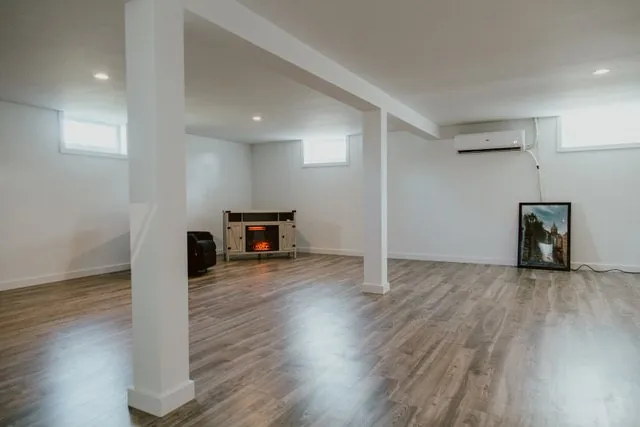
The pipe has to come up through the slab, and the fan and the pipe route to the outside wall have to go somewhere. In an unfinished basement that is a choice. In a finished one it is a hole through new flooring and a run through a bedroom closet or a new bulkhead, and the cracks and the sump lid that wanted sealing are under the subfloor by then.
There is a testing reason too. While the basement is unfinished, people often test upstairs because that is where they live, and the basement result never gets taken. Health Canada also recommends retesting in the heating season after a basement renovation, because new walls, a new bathroom fan or a new furnace can change the result.
So we would suggest testing first, in the fall, while the design and the permit are being worked out. If the number comes back high, the system gets planned into the layout. If it comes back low, a retest after the renovation is still recommended.
The 3 months fit inside the planning time on most basement projects, so a test started early rarely holds anything up.
We are happy to leave room in the plan for a future radon pipe and fan, so a certified mitigation professional can put a system in later without opening finished walls.
Basement Renovations
Basement renovations and full basement development in Red Deer and Central Alberta, built dry and warm for Alberta winters.
See Our Basement Renovations Work →Before you sign a quote: What a complete basement quote includes
More from the Green Ladder Blog
David Hutten
Owner, Green Ladder Contractors
David Hutten started building at age 10 and has more than 30 years of hands-on construction experience. Green Ladder Contractors renovates kitchens, bathrooms and basements and builds home additions, garages and decks across Red Deer and Central Alberta.
Ready to start your project?
Book a free 15-minute discovery call. We'll walk through your vision, budget, and timeline.