
Spray Foam vs Batt Insulation in an Alberta Basement
Spray foam is air barrier and insulation in one. Batt needs a separate vapour barrier done properly. Why the difference matters below grade here.
By David Hutten, Owner, Green Ladder Contractors
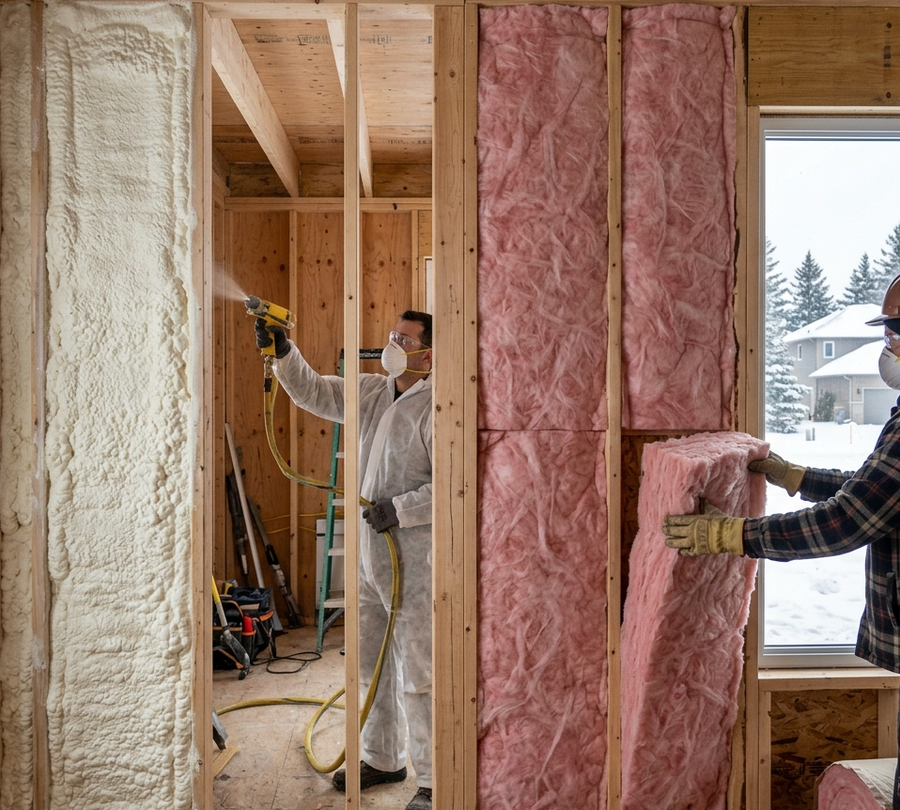
This is the decision that has the biggest effect on whether a finished basement is comfortable, and it is the one homeowners are given the least information about. Both approaches work. They fail differently, and one of them depends entirely on the care taken installing it.
What each one is doing
Batt insulation is fibre, usually mineral wool or fibreglass, friction fit into the stud bays. It slows heat moving through. It does nothing to stop air moving, so it needs a separate vapour barrier on the warm side, sealed continuous, to stop interior air carrying moisture into the wall.
Closed cell spray foam is applied as a liquid that expands and cures rigid. At sufficient thickness it is insulation, air barrier and vapour retarder in one application, which is why the assembly around it is simpler.
The Alberta problem both are solving
Warm interior air holds moisture. A basement foundation wall is cold. If warm moist air reaches a cold surface inside the wall assembly, the moisture condenses there, behind the drywall, where nobody sees it until there is a problem.
That is the entire job. Insulation and vapour control only work as a pair, and getting one right while getting the other wrong is worse than doing neither, because a half sealed wall traps what gets in.
Why a stud wall never goes tight against the concrete
Whichever insulation you choose, the framing gets built off the concrete rather than against it. A stud wall pressed to a cold foundation wall is exactly where condensation collects, and it puts wood in permanent contact with a damp surface.
Standing it off lets the assembly be insulated properly and lets air move behind it. It is also why rigid insulation is often used against the concrete itself before the framing goes up, which keeps the concrete face warmer and moves the condensation point out of the wall.
Where batt goes wrong
Not in the batt. In the vapour barrier. Continuous is the operative word, and the gaps are where it fails: around electrical boxes (the one behind an outlet is the classic), at the top and bottom plates, at every penetration, at the seams.
A vapour barrier that is stapled up and taped carefully at every one of those points performs. One that is stapled up quickly and left with a torn corner behind an outlet does not, and you cannot tell the difference by looking at the finished wall.
Batt also has to fill the bay without being compressed. Compressed insulation loses value, and a batt stuffed in behind a wire is not doing its rated job.
Where spray foam goes wrong
Thickness and coverage. Closed cell foam has to be applied thick enough to act as a vapour retarder, and thin spots do not perform. It is sprayed by a certified applicator, and the space has to be vacated during application and for a cure period.
It is also difficult to modify later. Running a new wire through a foamed wall means cutting foam out and re foaming, and that changes how you think about roughing in for things you might want later.
The hybrid a lot of Alberta basements end up with
Rigid foam board against the concrete, taped at the seams, with a framed wall in front of it insulated with batt and a continuous vapour barrier. That gets the cold face of the concrete covered by a continuous layer, which is the part that matters most, and keeps the stud bays accessible.
This is a common approach for good reasons. It is also the one where the seam taping and the vapour barrier detailing carry the whole assembly, so it is only as good as the attention it gets.
What to look for in the quote
A specified insulation type and a value, not just the word insulated. The word continuous next to the vapour barrier, and a statement about how penetrations are sealed. The framing described as built off the concrete. Whether the rim joist area is being addressed, because it is a major heat loss point that gets skipped.
And an order of operations: moisture, framing, rough-in, inspection, insulation, vapour barrier, drywall. The sequence is what makes each step inspectable while it can still be corrected. Trying to insulate or board before the rough-in inspection passes is a classic and expensive mistake.
Spray foam or batt: which suits an Alberta basement?
Batt with a properly detailed vapour barrier is the standard approach and it works when it is done carefully. Spray foam removes the dependence on that care and costs more for it. If you are choosing on a basement that has ever shown moisture, deal with the moisture first, because no insulation strategy fixes water coming through concrete.
Basement Renovations
Basement renovations and full basement development in Red Deer and Central Alberta, built dry and warm for Alberta winters.
See Our Basement Renovations Work →Before you sign a quote: What a complete basement quote includes
More from the Green Ladder Blog
David Hutten
Owner, Green Ladder Contractors
David Hutten started building at age 10 and has 25 years of hands-on construction experience. Green Ladder Contractors builds custom outdoor living spaces, decks, fences, pergolas, and landscaping, across Red Deer and Central Alberta.
Ready to start your project?
Book a free 15-minute discovery call. We'll walk through your vision, budget, and timeline.