
Refinishing vs Replacing Hardwood: How to Tell
Most hardwood floors can be refinished several times. How to check whether yours can, and the four situations where replacing is the only answer.
By David Hutten, Owner, Green Ladder Contractors
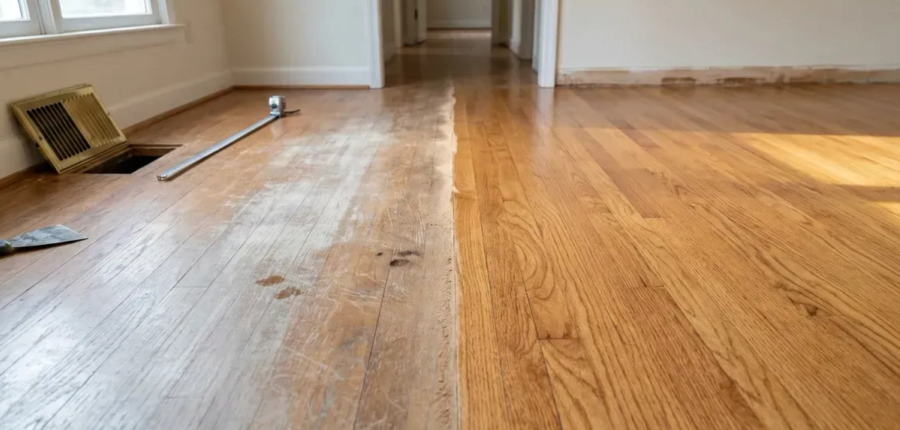
Hardwood that looks finished is often not. Scratches, dullness and dark traffic paths are surface problems, and the surface is the part that comes off. Before you price a new floor, it is worth knowing whether the one you have has another life in it.
How many times can a hardwood floor be refinished?
Solid hardwood typically has a good amount of wear layer and can usually take several refinishes over its life. Engineered hardwood has a veneer over a plywood core, and the veneer thickness varies enormously between products. A thick veneer can be refinished once or twice. A thin one cannot be sanded at all.
Refinishing sands away a thin layer of wood. What matters is how much wood sits above the tongue, because once you sand into the tongue the board loses its edge support and starts to break up.
You can check without guessing. Pull a floor vent or a threshold and look at the cut edge of a board (a heat register is the easiest one to lift). You will see the layers, and you will see how much sits above the tongue.
When refinishing is the answer
Surface scratches, worn finish, dull traffic lanes, pet damage in the finish, and a colour you have stopped liking. All of that is finish, not wood, and all of it sands off.
Refinishing also lets you change colour completely, which is the cheapest way to change how a whole floor of a house reads.
The four situations where replacing is the only answer
Water damage that has cupped or crowned the boards. Cupping sometimes relaxes once the moisture source is fixed and the wood dries out, so this one is worth waiting on before deciding. If the boards have separated at the ends or the tongues have failed, it is done.
Too little wood left. If it has been sanded several times already, or the veneer on an engineered floor is thin, there is nothing to take off.
Subfloor problems. If the floor moves, squeaks across a whole area, or has dips you can feel, sanding the top does not address any of that. The subfloor gets checked and flattened first regardless, and if it needs work, the floor above it is coming up anyway.
You want a different layout or a different product. A refinish keeps the boards you have, in the direction they run, at the width they are.
What refinishing actually involves
Sanding in stages with progressively finer grits, then edging where a drum sander cannot reach, then finishing. Dust is the part people underestimate. Even with dust containment, sanding a floor puts fine dust through a house, and containment is real work that belongs in the scope.
The finish needs to cure, and cure time is not the same as dry time. You can usually walk on it well before you can put furniture back or lay a rug down, and putting a rug on a floor that has not cured will leave a mark you cannot sand out without doing it all again.
Why do hardwood floors gap in winter?
Our indoor humidity swings hard between summer and a heated winter. Wood moves with it, which is why hardwood floors get gaps in February that close again in July. That is normal and it is not damage.
It does matter for timing. Refinishing a floor at its most contracted point in a dry winter, and filling those gaps, means the filler gets squeezed out when the boards expand again. A floor that has acclimatised to normal indoor conditions is the one to work on.
Partial replacement is a real option
If damage is confined to one area, boards can be woven in and the whole floor refinished so the repair disappears. Matching new boards to old is much easier when the entire floor is being sanded and finished together afterward.
This is often the answer where a wall came out, or where a fridge leaked in one spot, and it is worth asking about before committing to a full replacement.
What to ask for in the quote
Whether the existing floor has been assessed for remaining wear layer, and what was found. The number of sanding passes and the grits. The finish product by name and the number of coats. Cure time before furniture returns. Dust containment named in the scope. And if boards are being woven in, how many and where.
Interior Renovations
Basement development, kitchen and bathroom remodels, and whole-home interior renovations across Red Deer and Central Alberta.
See Our Interior Renovations Work →Before you sign a quote: What a complete interior renovation quote includes
More from the Green Ladder Blog

David Hutten
Owner, Green Ladder Contractors
David Hutten started building at age 10 and has 25 years of hands-on construction experience. Green Ladder Contractors builds custom outdoor living spaces, decks, fences, pergolas, and landscaping, across Red Deer and Central Alberta.
Ready to start your project?
Book a free 15-minute discovery call. We'll walk through your vision, budget, and timeline.