
How to Choose Retaining Wall Materials for Alberta Soil
Alberta's clay-heavy soil and extreme freeze-thaw cycles eliminate some retaining wall options entirely. Here's how to choose the right material for your site and your grade change.
By David Hutten, Owner, Green Ladder Contractors
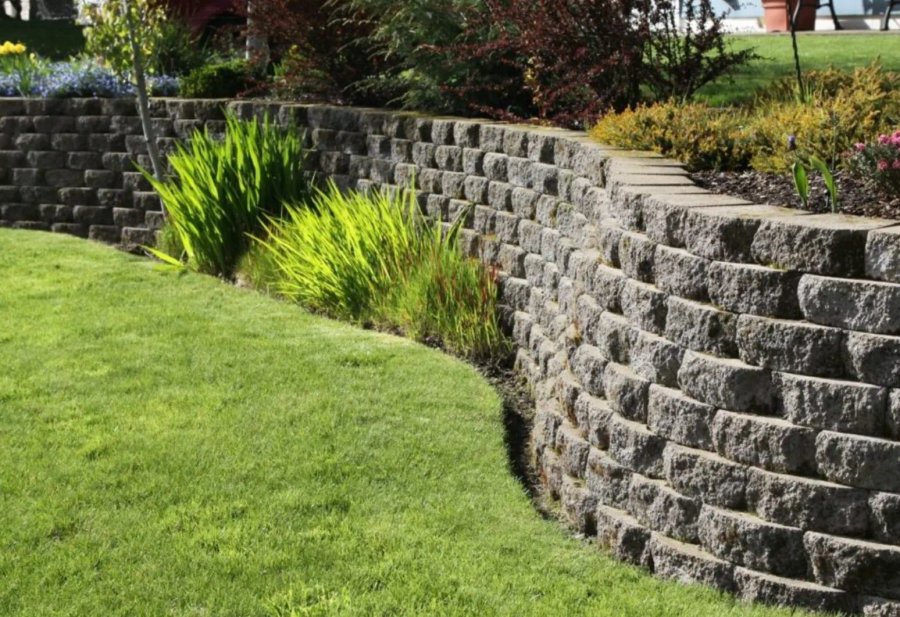
Retaining walls fail more often in Alberta than in temperate climates because Alberta's soil and climate create specific demands that not all materials and installation methods meet. Clay-heavy soil expands when wet and freezes. Freeze-thaw cycles generate lateral pressure that pushes walls out over time. The right material for a retaining wall in Central Alberta isn't just an aesthetic choice, it's an engineering one.
What makes Alberta soil challenging for retaining walls
Much of Central Alberta sits on clay-heavy glacial till. Clay expands significantly when it absorbs water and contracts when it dries. This expansion and contraction creates lateral pressure on whatever is retaining it. Combined with freeze-thaw cycles that happen multiple times through spring in Red Deer, this pressure can be enormous.
The two things that address this: proper drainage behind the wall (reducing water pressure) and a material system that can handle the lateral load over time. A wall without drainage eventually fails from hydrostatic pressure regardless of material. A wall with drainage but inadequate structural design fails from lateral soil pressure.
Concrete block: the best all-around choice for Alberta
Interlocking concrete block systems, Versa-Lok, Allan Block, and similar engineered products, are our primary specification for most retaining wall projects in Central Alberta. Here's why:
The blocks are engineered with a batter, a backward tilt built into the unit, that naturally distributes lateral load into the retained grade rather than fighting it. This is a fundamental difference from timber walls, which are plumb (vertical) and resist the full lateral load through the structure.
The pinned connection between block courses allows the wall to flex slightly under frost pressure and return to position, significantly different from a rigid masonry wall that cracks under the same movement.
Geogrid reinforcement, horizontal mesh layers extending back into the retained grade, is standard for walls over 3'. Geogrid distributes the lateral load over a much larger soil mass, dramatically increasing the effective strength of the wall system.
For most residential retaining walls in Red Deer and surrounding communities, grades from 2' to 8', residential loading, standard soil conditions, interlocking concrete block with drainage and geogrid is the right material.
Pressure treated timber: the right choice for smaller applications
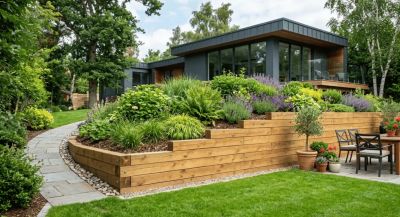
PT timber retaining walls (6x6 or 8x8 lumber, horizontal deadman anchors) are appropriate for grade changes under 4' to 5' where budget is a constraint and a natural wood aesthetic is preferred. They install faster and cost less than concrete block for small applications.
The limitations are important: timber walls are plumb, which means they fight lateral load rather than redirect it. They depend on the deadman anchors to resist rotation. And they have a finite lifespan, even quality PT lumber in an Alberta wall environment has a 20-30 year practical life before the wood degrades enough to affect structural performance.
For small garden walls, grade definition around planting beds, or low budget constraints, timber is a reasonable choice. For walls over 4' or walls where longevity matters, block is the better investment.
Natural stone: the permanent choice
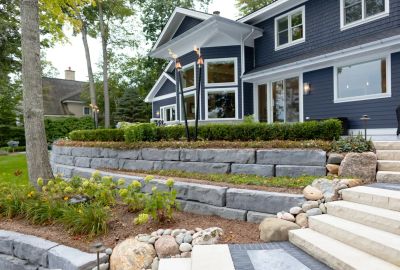
Fieldstone and armour stone retaining walls are the most permanent option. Dry-stacked fieldstone walls handle frost movement naturally, there's no mortar to crack, and the irregular stone mass adjusts slightly with soil movement and recovers. Armour stone (large quarried boulders placed by equipment) is both a structural and aesthetic element that lasts indefinitely.
The limitations are cost and access. Armour stone requires heavy equipment for placement. Both stone options require significantly more skilled labour than block installation. But for the right application, an acreage property with dramatic grade changes, a client who wants a completely natural aesthetic, stone walls are the premium choice that outlasts everything else.
The drainage system that applies to all materials
Regardless of material, every retaining wall we build includes: excavation behind the wall for drainage aggregate, geotextile fabric to prevent soil migration into the aggregate, 4" perforated drainage pipe (weeping tile) at the base of the wall, and drainage outlets at regular intervals through or around the wall.
A wall without this drainage system is a wall with a failure mode built in. We don't build retaining walls without drainage. If you're getting quotes on a wall and drainage isn't specified in the scope, ask specifically what's included for water management behind the wall.
Permits for retaining walls in Central Alberta
Walls over 4' in height typically require a building permit and, in many municipalities, stamped engineering drawings. The permit process for a retaining wall in Red Deer involves submitting a site plan showing wall location relative to property lines, a wall cross-section showing drainage, footing, and batter details, and material specifications. We tell you which permits apply, give you the 3D design and the footing details for the application, and make sure the work is ready at every inspection. In Alberta you sign the permit, because it is your property.
Retaining Walls & Steps
Engineered drainage, frost-rated bases, and geogrid reinforcement on every wall we build.
See Our Retaining Walls & Steps Work →Before you sign a quote: What a complete retaining wall quote includes
More from the Green Ladder Blog
David Hutten
Owner, Green Ladder Contractors
David Hutten started building at age 10 and has 25 years of hands-on construction experience. Green Ladder Contractors builds custom outdoor living spaces, decks, fences, pergolas, and landscaping, across Red Deer and Central Alberta.
Ready to start your project?
Book a free 15-minute discovery call. We'll walk through your vision, budget, and timeline.