
Moving Plumbing and Electrical in a Kitchen Reno
What drives the cost of moving a kitchen sink, adding circuits or relocating a range in a Red Deer home, and which moves are the expensive ones.
By David Hutten, Owner, Green Ladder Contractors
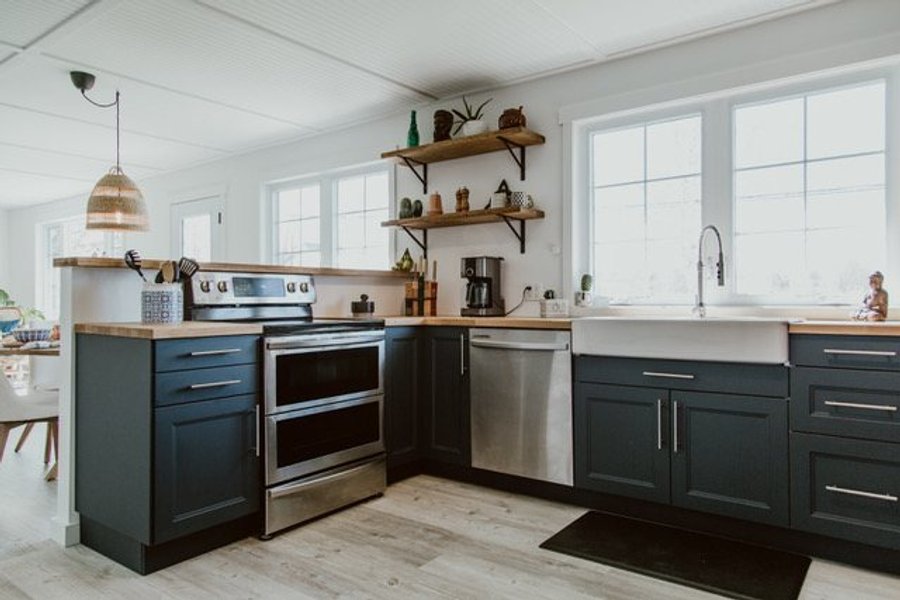
Two kitchens with identical cabinets and identical counters can come in many thousands of dollars apart, and the gap is almost always behind the drywall. Here is what drives that number, so you can decide which moves are worth it before you are committed.
What decides the cost of moving a kitchen sink?
The cost of moving a fixture is not about distance. It is about what is under the floor and what direction the joists run.
Moving a sink 3' along the same wall is usually straightforward (3' on a drawing, anyway). The drain still falls the right way, the vent is still in range, and the plumber is working inside one bay. Moving that same sink to an island in the middle of the room means cutting into the floor, running new drain with proper fall, and solving the vent, which usually means an island loop vent or an air admittance valve depending on what the inspector will accept. Same fixture, same 3' on the drawing, completely different job.
That is the general rule for everything in this article. Along the wall is cheap. Across the room, into an island, or onto an exterior wall is not.
Plumbing: What Is Cheap and What Is Not
In rough order, least to most expensive:
Adding a dishwasher where there was never one, assuming it lands next to the sink, is one of the smaller plumbing changes in a kitchen.
Relocating a sink within the same wall is next. The drain still falls the right way and the vent is still in range.
Moving a sink to a different wall costs substantially more, and more again if the drain has to cross joists instead of running with them.
Running plumbing to a new island is the most expensive plumbing move in a normal kitchen, and it has the widest spread of any item on this list. It depends almost entirely on what is under your floor.
That last point is the one to take away. Basement access is the single biggest variable in kitchen plumbing. If we can reach the underside of your kitchen floor from an unfinished basement, these moves are far cheaper. A finished ceiling below means opening it and putting it back, and a slab means a different job entirely.
Electrical: What Is Cheap and What Is Not
Kitchens changed a lot in the code. A modern kitchen needs dedicated circuits for the dishwasher, the fridge, the microwave and the range, plus split or protected counter receptacles at proper spacing and tamper resistant devices. Plenty of older Red Deer kitchens have one or two circuits doing all of it.
Individually, most kitchen electrical work is modest: adding receptacles, adding a dedicated 15 or 20 amp circuit, under-cabinet lighting, pot lights. These are small line items and they add up predictably.
A range circuit at 40 or 50 amps costs more than a standard circuit but is still a contained item.
The one that is not modest, and the one that surprises people: if your panel is full, or the house is on a 60 or 100 amp service, a modern kitchen can be what forces a service upgrade. That is a large, separate cost, and it is not optional if the load calculation says so. It can be the single biggest line in an otherwise straightforward kitchen.
This is why we look at the panel first in any home built before about 1990. Finding it in week two is a bad conversation for everybody.
What We Find Opening Walls in Older Homes
In Red Deer houses from the 1960s through the 1980s, the recurring ones are aluminum branch wiring that needs proper pigtailing or replacement, no ground on the counter circuits, a range circuit sized for a much smaller stove, and drain lines that were never vented correctly and have been quietly working anyway.
None of these are disasters. All of them are cheaper to fix while the wall is open than at any other point in the life of the house. If you are going to be in there anyway, be in there once.
What is the biggest saving in a kitchen renovation?
If your budget is tight, keeping the sink and the range where they are is the single largest saving available in a kitchen renovation. You can change every visible thing in that room, cabinets, counters, backsplash, flooring and lighting, without touching the wet wall. Moving the plumbing and adding an island with a sink is what pushes a kitchen into a different tier entirely.
That is not an argument against moving things. Sometimes the layout is the whole problem and moving the sink is exactly right, and we will tell you so. It is an argument for knowing which line on the drawing is the expensive one, before the drawing is final.
We do not publish dollar ranges for this work, because the spread between a house with open basement access and one on a slab, or between a panel with room and one that needs upgrading, is far too wide for a number to mean anything. What we can do is look at your panel, your basement and your floor structure, and tell you which of these apply to your house before you commit to a layout.
Kitchen Renovations
Full kitchen renovations in Red Deer and Central Alberta, managed from demolition to the final fixture.
See Our Kitchen Renovations Work →Before you sign a quote: What a complete kitchen quote includes
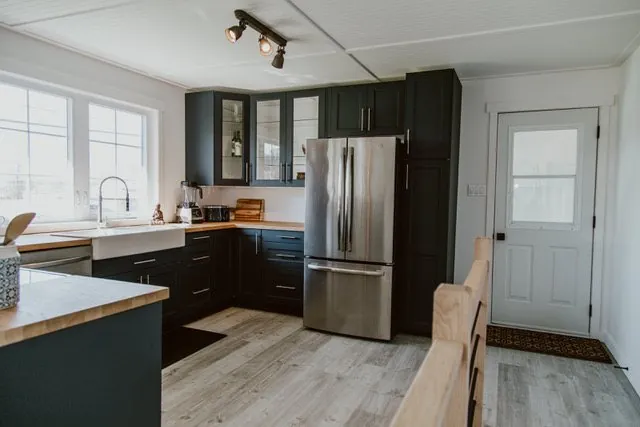
One we built
More from the Green Ladder Blog

David Hutten
Owner, Green Ladder Contractors
David Hutten started building at age 10 and has 25 years of hands-on construction experience. Green Ladder Contractors builds custom outdoor living spaces, decks, fences, pergolas, and landscaping, across Red Deer and Central Alberta.
Ready to start your project?
Book a free 15-minute discovery call. We'll walk through your vision, budget, and timeline.