
Will Your Shed Survive an Alberta Winter?
Snow load, frost heave, and chinook wind are what break sheds in Central Alberta. What to look for in a shed built for this climate rather than a mild one.
By David Hutten, Owner, Green Ladder Contractors
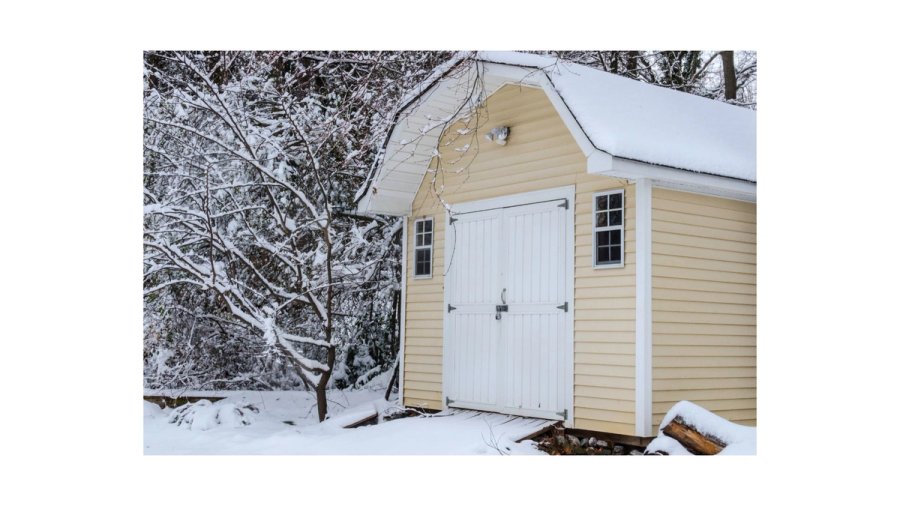
Three things break sheds in Central Alberta, and none of them is age. Snow on the roof, frost under the floor, and wind against the walls.
A building designed for a milder climate handles all three badly. Here is what each one does and what a shed built for this place does about it.
Snow Load
Ground snow load is a local number. It is not a general standard, and a roof built to a general standard is built for somewhere else.
Snow is heavy, and wet spring snow is much heavier than the light stuff in January. The roof also does not load evenly. Wind scours one slope and drops it on the other, and drifting against a fence or a house wall piles it deeper on one side than the design assumed.
What matters:
Rafters or trusses sized for the local ground snow load, not for a catalogue.
Pitch. A steeper roof sheds more and holds less. A low slope holds everything that lands on it until it melts.
Where the snow slides to. A roof that dumps its load in front of the door means shovelling the door out before you can open it. Orientation is a design decision, not an accident.
The failure mode is rarely dramatic. It is a roof that sags slightly over a few winters, which opens the joints, which lets water in.
Frost Heave
This is the one that does the most damage and gets the least attention.
Water in the soil freezes, expands, and lifts whatever sits on top. It never lifts evenly. One corner rises more than another, the building racks out of square, and then the doors bind, the corners open, and water gets in.
A shed on a few patio blocks or straight on grass will do this. It is not a question of whether.
What prevents it:
A compacted gravel pad under treated skids. Gravel drains, so water has somewhere to go instead of sitting under the building and freezing there. The pad has to be excavated and compacted in lifts. A few inches of gravel raked flat is not a gravel pad.
Concrete piers below frost depth. The load sits on ground that does not freeze. This is the answer on sloping, soft, or wet ground.
A poured slab, for workshops and anything heated.
Getting the floor structure clear of wet grade matters as much as the frost itself. A floor sitting close to damp ground stays damp, and a damp floor does not last regardless of what the frost does.
Chinook Wind
Chinooks are strong, they arrive fast, and they hit a shed broadside.
Kit sheds are frequently not anchored at all, which is how buildings end up against the back fence. Anchoring the building to its foundation is the fix, and it is not an upgrade or an extra. A shed that shifts off its base has lost its foundation whether or not the foundation was well built.
The freeze and thaw cycling that comes with chinooks is the quieter problem. Central Alberta goes above and below freezing repeatedly through a winter rather than staying frozen. Every cycle moves water in and out of materials. Anything that traps moisture, or any joint that has opened up, gets worked on all winter long.
What a Shed Built for Here Looks Like
- A foundation chosen after looking at the drainage and the grade, not chosen by price
- The floor framed like a deck, treated, at 16 inches on centre, on a plywood deck rated for the load
- Walls at 16 inches on centre with real headers over the openings
- A roof sized for the snow that actually falls here
- Flashing detail at every joint where water could get in
- The building physically tied to its foundation
That list is the difference between a shed that is square in fifteen years and one that needs the door planed after two winters.
The Tell on an Existing Shed
If you have a shed already and want to know how it is doing, check the door. A door that binds, sticks, or has been planed to keep closing is telling you the building has moved. That is a foundation report, not a door problem.
Check the corners next. Gaps opening at the corner trim mean the same thing.
Green Ladder builds sheds, workshops, and studios across Red Deer and Central Alberta, sized and detailed for this climate rather than a general one. Every one starts with what is going underneath it.
Custom Sheds
Site-built storage sheds, workshops, and studios across Red Deer and Central Alberta.
See Our Custom Sheds Work →More from the Green Ladder Blog
David Hutten
Owner, Green Ladder Contractors
David Hutten started building at age 10 and has 25 years of hands-on construction experience. Green Ladder Contractors builds custom outdoor living spaces, decks, fences, pergolas, and landscaping, across Red Deer and Central Alberta.
Ready to start your project?
Book a free 15-minute discovery call. We'll walk through your vision, budget, and timeline.